

I love teaching about gender equality and facilitating LGBT+ inclusive workshops. In my services, this involves sharing histories of queer and trans people of colour from the global majority. I do this to disrupt the pattern of whiteness in LGBT+ human rights and LGBT history, which often excludes people of colour and those from the Global Majority.
As a black queer person from the Caribbean, it used to feel like ‘Queer History’ was born out of Europe and North America. But those identities don’t reflect me. Over time, I saw that diverse “LGBT+ histories” can still gloss over colonial histories and power imbalances.
Lucky for you all, I’m an award-winning educator and avid researcher! This week, I launch my new social media and blog series, “Genderfluid Histories for Queer and Trans People of Colour“. These posts are inspired by my identities, informed by my research, and influenced by the books I’m reading.
This week is inspired by Paula Akpan’s new book, When We Ruled: The Rise and Fall of Twelve African Queens and Warriors. I highly recommend this book to EVERYONE! Feel free to share these posts on your socials, but please tag me as the author on social media by linking back to this website or any of my socials below.
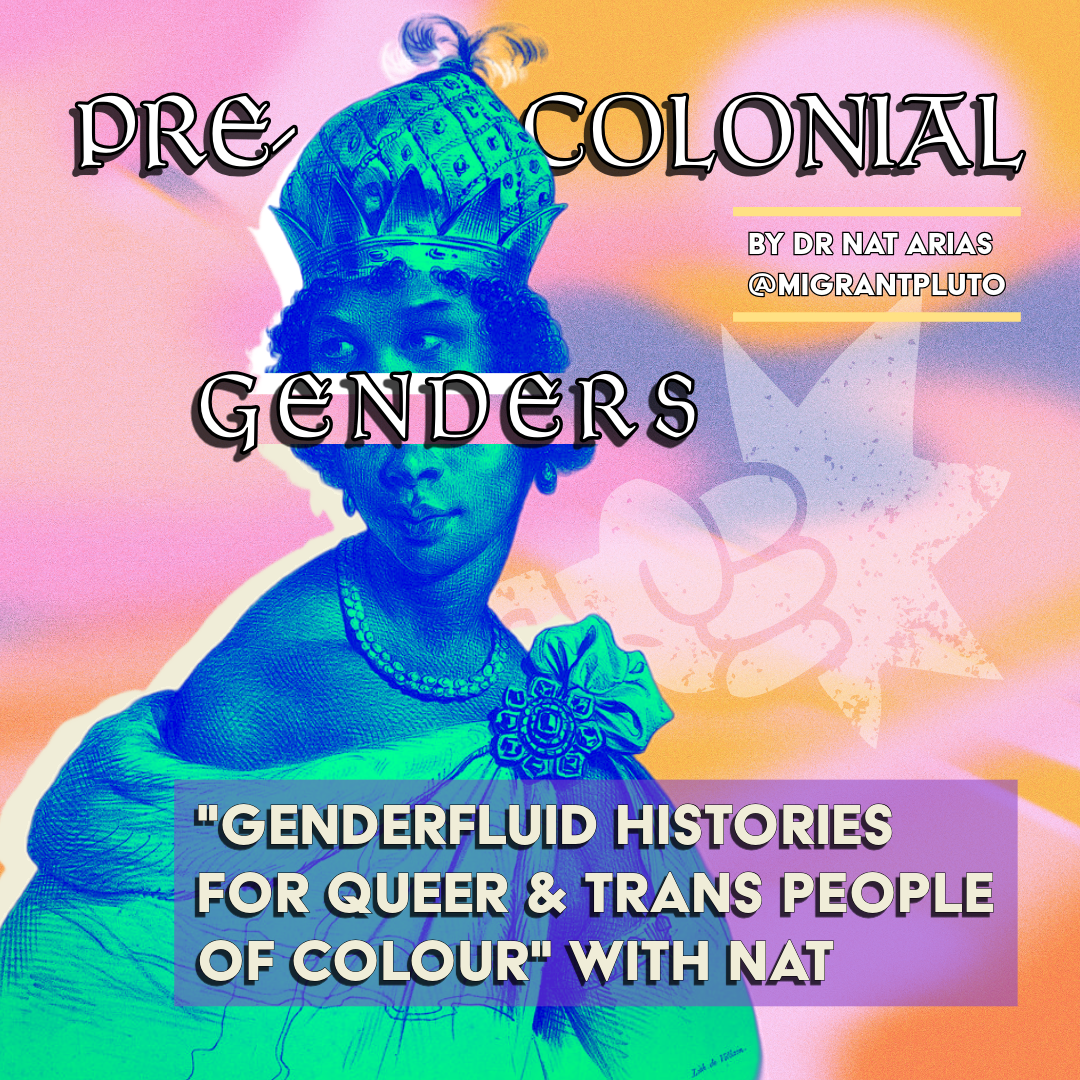
NJINGA OF NDONGO AND MATAMBA (1583 – 1663)
Learning histories of Queer and Trans* people of colour helps us reflect on how “gender” changes, structures everyday life, and influences who is ‘remembered’. But LGBT+ history in Europe often applies a white, middle-class understanding of gender and sexuality (and ‘trans-ness’) onto ‘Other cultures’ to selectively include people of colour into Queer historical narratives. This means that “inclusion” comes at the expense of glossing over power imbalances in current and historical communities.
Described by Paula Akpan as a “binary-defying sovereign who bargained with the lives of enslaved people”. She writes
“Njinga embodied transgression, especially of European norms. They commanded their own troops […] wore what was understood by the Portuguese as masculine garb; they used a male-coded name, especially in military settings… ” (Akpan 2025; p.56-57).
Njinga expressed themselves fluidly, sometimes identifying as a king. Their kingdom had other gender variant people. Their language did not have gendered pronouns or terms assigned on the basis of gender.
Ruling for 40 years, Njinga defied 13 Portuguese governors with their wit, military prowess and brutality. Njinga accepted the trade and transportation of enslaved people through their lands. In fact, the transport of enslaved peoples significantly increased during their reign (a departure from the actions of previous rulers). They secured a monopoly in the exports of enslaved people by forcing European imperial allies with ‘cargo’ to pass through their capital city (and pay taxes).
What can we gain from including histories like Njinga (and other imperial baddies) in discussions about the struggles of queer and trans people of colour?
How does Njinga fit within postcolonial analysis of European empires and African kingdoms?
Yes, Njinga’s legacy is messy. And that’s helpful! I’m tired of only remembering queer people of colour who lived like saints. And as a Black queer NB from the Caribbean, Njinga definitely stretches our understandings of genders, the Atlantic Slave trade, and anti-colonial resistance.
Do you have questions about Njinga or Paula’s book? Come and ask me and Paula! I’ll be chairing the panel, “Is a Shared History Possible” with authors Paula Akpan, Kit Heyam and Jane Traies on Oct 12 at 12:15pm.
And remember to follow me on Linkedin, Instagram or follow my website for more!
